Ghosts
The Reincarnated Demon King's Host Just Wants to Live in Peace, But the Hero Won't Leave Him AloneGhosts are the dead as an active presence in the world of the living, capable of frightening communities, transmitting ghost-touch, and carrying the emotional force of their unfinished histories. They are not treated as a single undifferentiated species of monster: some belong to ordinary seasonal belief, while others become dangerous through grievance, violence, or supernatural nesting. Their appearances therefore connect horror with memory and make the treatment of the dead a test of communal responsibility.
Nature and Folkloric Context
Ghosts are familiar enough to form part of local custom and seasonal expectation. When the Hero’s party approaches Ashenhave at dusk, Veiv explains that it is the time of year when ghosts are especially likely to appear, while the town’s temporary fencing, darkened windows, and nightfall restrictions show that seasonal knowledge has become a practical emergency. Wicker, whose specialty is dealing with ghosts, emphasizes that they can be terrifying either by choice or because they have been wronged. This distinction gives the creatures an ethical dimension: fear is not their only defining quality, since their behavior may be connected to injury, anger, or an unresolved claim against the living.
The book also places ghosts beside ordinary funerary practice rather than isolating them as purely monstrous figures. After Glefald’s death, Leafel observes the elf’s wish to be buried in the earth with a tree planted above him instead of being released through the customary bonfire burial. The tree is intended to feed new life and eventually stand as a second guardian beside the Watchtower. The villagers honor that request, and the funeral becomes a communal act of placement, remembrance, and continuity. The contrast with the Ashenhave haunting suggests that the dead can remain part of a community without becoming a threat when their wishes are recognized and their memory is given a respectful form.
The Ashenhave Crisis
The ghost crisis becomes visible before the party understands its source. Ashenhave is surrounded by makeshift barriers, its farms and houses are dark, and the residents refuse to admit travelers after nightfall. The Hero’s party identifies itself, but the sentry demands proof and tells them to survive outside until morning. Wicker explains that the people are afraid because ghosts can be terrifying, and Theo responds that healing could treat the effects if a ghost touched someone. The exchange establishes the town’s isolation while also revealing that the party’s usual heroic status offers no automatic protection from local fear.
Inside the inn, the supernatural danger has already become physical. The common room has been emptied of tables and chairs and converted into rows of bedrolls for at least a dozen victims. Theo detects ghost-touch in the air, comparing its smell to old blood, rust, and freshly turned grave dirt. The victims’ exposed skin is grey and blue, with lips, eyelids, and nostrils appearing almost frostbitten. Ghosts therefore threaten the living not only through apparitions or fear but through a condition that visibly changes the body and demands a healer’s intervention.
Wicker later identifies the structure behind the outbreak. An old ghost connected to an abandoned well in the forest has stirred up the other ghosts, probably including people it killed and former residents of Ashenhave. The source has nested, making it more dangerous and explaining why the party hesitated to confront it immediately after Theo touched it. The haunting is thus cumulative: one powerful and corrupted presence gathers other dead around itself, turning private histories and local deaths into a collective assault.
The Abandoned Well and the Nested Ghost
The source lies beyond a small glen, where a moss-covered well remains intact after its wooden winch and cover have rotted away. The ruined structure produces a distant calling or screaming, as though voices are traveling through the forest from far below. Its physical decay makes the well a fitting vessel for the buried past: the useful machinery has disappeared, but the stone enclosure remains, preserving access to something that should have been left undisturbed.
The confrontation reveals the nested ghost as a corpse-like creature rather than an invisible presence. Wicker uses an oil-filled lantern and a torch marked with fire-spell runes, while Cargo stays near Theo because Wicker expects the entity to focus on him. As Theo enters the glen, he hears a child begging to go home. The nested beast recoils from the bright green force of his healing magic, giving Wicker the opening to set its rotten flesh and fur alight. The fire burns through the creature until it is barely a skeleton, and the beast collapses as the flames consume it.
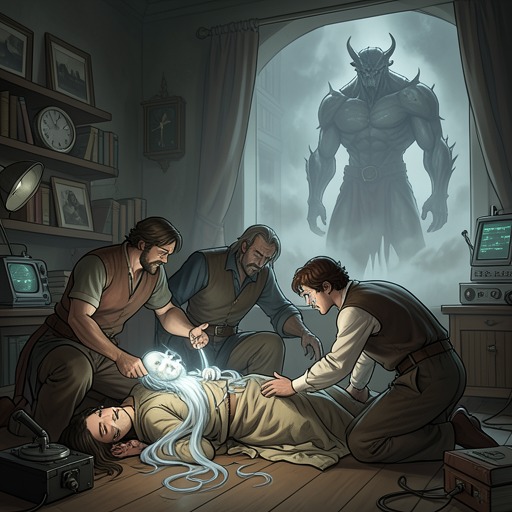
Destruction of the body does not end the encounter’s meaning. After the fire fades, a silvery glow appears above the blackened remains and forms the clearer figure of a boy, with tears visible on his cheeks. His repeated plea to go home and his reminder of a promise transform the scene from a simple monster-killing episode into an appeal from a dead child. Theo answers by offering help and extending his arms, using healing magic not merely to repair a living body but to guide a disturbed spirit toward release. The nested ghost is overcome through fire, but the boy’s ghost is addressed through recognition and assistance.
Ghosts, Memory, and Release
Ghosts carry emotions and memories as an active force. Wicker explains that Theo heals more slowly after being bombarded by the ghost’s emotions and memories, showing that contact can overwhelm a living person even when the injury is not a conventional wound. The haunting consequently crosses the boundary between bodies and minds: the dead do not simply attack from outside, but impress their accumulated experience upon whoever encounters them.
The Ashenhave ghosts also embody the consequences of violence that has not been integrated into communal memory. The old source is linked both to its own victims and to the town’s former residents, so the outbreak gathers individual deaths into a shared historical disturbance. The story does not provide a detached catalogue of every spirit’s identity; instead, it presents the haunting as a mass of wronged or murdered dead whose unresolved presence has become impossible for Ashenhave to contain. The town’s barriers and night lockdown are defensive measures, but they cannot resolve the history that produced the ghosts.
Against that violent accumulation stands the quiet memorial for Glefald. The elf’s body is lowered into the earth, a sapling is planted over it, and Liffey sings in her own language while the villagers take turns adding soil. The dead elf is remembered through a living tree, handmade knitwear, and a scarf intended as a solstice gift. These gestures do not erase death; they give grief a place, a season, an object, and a future. The contrast implies that remembrance can become protective rather than predatory when it is shared and honored.
Narrative Significance
Ghosts broaden the book’s conflict beyond battles between the living and supernatural enemies. They expose the costs of abandonment, murder, neglected promises, and unprocessed grief, while forcing the Hero’s party to distinguish between a creature that must be stopped and a spirit that must be understood. Wicker’s expertise gives the group a practical means of confronting the crisis, but Theo’s response to the boy reveals the deeper principle governing the encounter: the dead may require compassion as much as resistance.
Their presence also connects private mourning with public order. Ashenhave’s barriers represent a community trying to control fear through exclusion, whereas Leafel’s funeral represents a community making room for death without surrendering to it. Across these scenes, ghosts are neither merely evidence of a gothic atmosphere nor interchangeable enemies. They are reminders that the boundary between life and death remains ethically charged, and that peace for the living may depend on whether the dead are treated as disposable remnants, dangerous forces, or persons whose final wishes still matter.